Gaya pada piringan dari grafik kecepatan
Soal
10) Dua gaya horizontal dan bekerja pada sebuah piringan bermassa dan meluncur di atas permukaan es yang licin dimana permukaan es tersebut dapat digambarkan sebagai sistem koordinat . Gaya dalam arah +, sedangkan gaya memiliki besar . Gambar di bawah memberikan komponen arah dari kecepatan piringan ( ) sebagai fungsi dari waktu selama meluncur. Bila nilai kosinus sudut antara arah tetap dari gaya dan adalah 3/4, maka besarnya gaya adalah ... N.
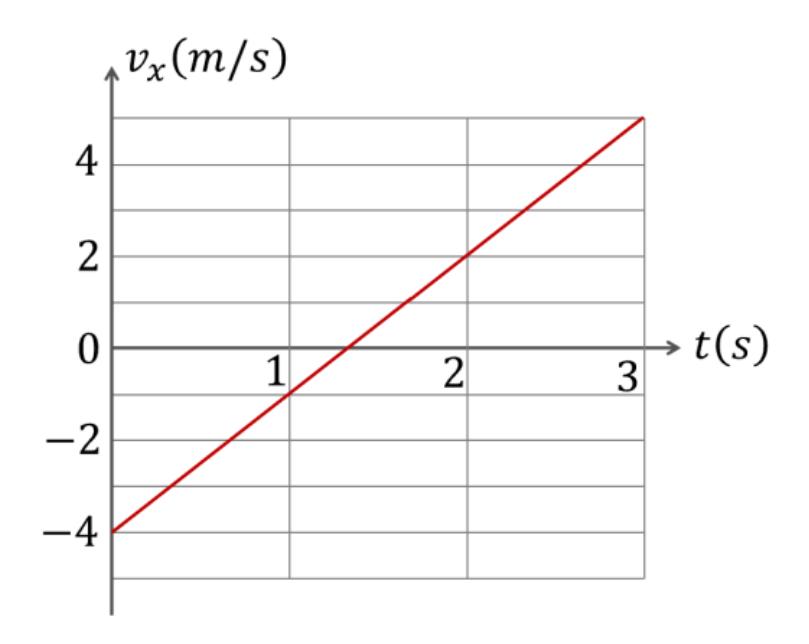
Pada soal ini kita diminta menentukan besar gaya yang bekerja pada piringan bermassa yang meluncur di atas es licin. Diketahui gaya berbesar dan kosinus sudut antara arah tetap dan sama dengan . Grafik komponen kecepatan terhadap waktu diberikan dalam gambar. Permukaan es licin berarti tidak ada gesekan, sehingga gaya-gaya horizontal adalah satu-satunya gaya yang mengubah percepatan dalam bidang .
Tentukan percepatan dari gradien grafik
Grafik versus adalah garis lurus, yang berarti percepatan konstan. Ambil dua titik yang jelas pada garis, misalnya dan . Gradiennya adalah Jadi percepatan piringan dalam arah adalah .
Gunakan hukum Newton II pada arah x
Gaya bersih pada arah adalah hasil kali massa dengan percepatan: Karena es licin, tidak ada gesekan yang menyumbang pada arah horizontal.
Komponen gaya F2 pada arah x
Gaya sepenuhnya sepanjang sumbu positif. Gaya memiliki besar dan membentuk sudut dengan sehingga . Komponen pada arah adalah
Selesaikan besar F1
Menurut hukum Newton II pada arah , jumlah gaya komponen sama dengan gaya bersih: Masukkan nilai yang diketahui: Oleh karena itu
Jawaban
Besar gaya adalah .
Force on the disk from the velocity graph
Problem
10) Two horizontal forces and act on a disk of mass sliding on a smooth ice surface, where the ice surface can be described as a coordinate system -. Force is in the + direction, while force has a magnitude of . The figure below shows the -component of the disk's velocity () as a function of time during its motion. If the cosine of the angle between the fixed directions of forces and is 3/4, then the magnitude of force is ... N.
In this problem we are asked to determine the magnitude of force acting on a disk of mass sliding on frictionless ice. Given force has magnitude and the cosine of the angle between the fixed direction and is equal to . The graph of the velocity component versus time is given in the figure. A frictionless ice surface means there is no friction, so the horizontal forces are the only forces that change the acceleration in the plane.
Determine the acceleration from the slope of the graph
The graph of versus is a straight line, which means constant acceleration. Take two clear points on the line, for example and . Its gradient is So the acceleration of the disk in the direction is .
Use Newton's second law in the x direction
The net force in the direction is the product of mass and acceleration: Because the ice is frictionless, no friction contributes in the horizontal direction.
Component of force F2 in the x direction
Force is entirely along the positive axis. Force has magnitude and makes an angle with so that . The component of in the direction is
Solve for the magnitude F1
According to Newton's second law in the direction, the sum of the component forces equals the net force: Substitute the known values: Therefore
Answer
The magnitude of force is .
SumberSource
Pembahasan OSK Fisika 2021 · Ahmad Basyir Najwan
HalamanPage 2Buka pembahasan di LabFisikaOpen in LabFisika · Buka soalOpen problem