Balok ditarik gaya miring pada lantai kasar
Soal
20) Sebuah balok bermassa yang awalnya diam ditarik dengan gaya = dan membentuk sudut hingga bergerak seperti pada gambar di bawah. Jika diketahui lantai kasar dengan koefisien gesek kinetis 0,75, maka energi kinetik maksimum balok setelah bergerak sejauh adalah ... J.
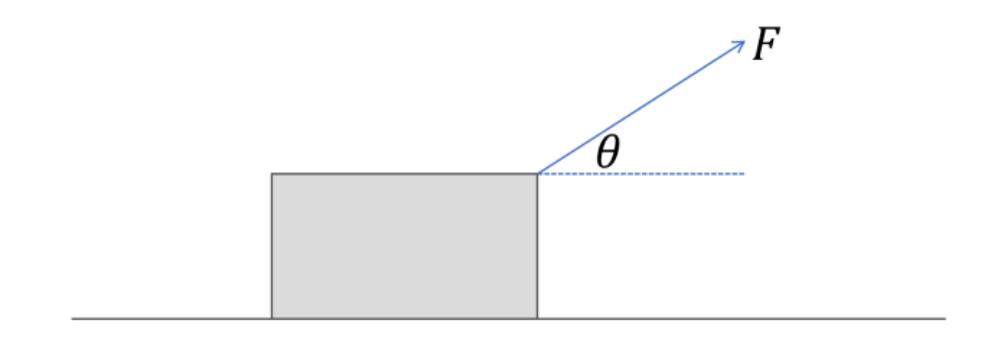
Sebuah balok bermassa mula-mula diam ditarik oleh gaya yang membentuk sudut terhadap horizontal di atas lantai kasar dengan koefisien gesek kinetis . Balok bergerak sejauh . Kita mencari energi kinetik akhir maksimum terhadap pemilihan , dengan menganggap balok tetap di lantai dan bergerak horizontal. Untuk nilai numerik yang konsisten dengan solusi sumber, digunakan .
Gaya vertikal dan gaya normal
Karena balok bergerak horizontal, percepatan vertikalnya nol. Komponen vertikal gaya memenuhi , sehingga
Gaya gesek kinetis
Karena lantai kasar dan balok bergerak, besar gaya gesek kinetis adalah Arahnya berlawanan dengan gerak.
Usaha total dan energi kinetik
Gaya normal dan gaya berat tidak melakukan usaha pada gerak horizontal. Usaha gaya tarik adalah , sedangkan usaha gesek adalah . Karena balok mula-mula diam, teorema usaha-energi memberi
Fungsi energi kinetik terhadap sudut
Substitusi menghasilkan
Maksimum terhadap sudut
Karena , memaksimumkan sama dengan memaksimumkan . Syarat stasionernya adalah sehingga Turunan keduanya untuk , jadi titik ini maksimum.
Komponen sinus dan kosinus pada sudut optimum
Dari diperoleh
Menyederhanakan faktor sudut
Substitusi komponen tersebut ke memberi
Energi kinetik maksimum
Dengan demikian,
Perhitungan numerik
Menggunakan , , , , dan : Maka
Pemeriksaan syarat gerak
Sudut optimum memenuhi , yaitu . Pada sudut ini , sehingga balok tetap di lantai dan asumsi gerak horizontal konsisten.
Jawaban
Energi kinetik maksimum balok setelah bergerak sejauh adalah .
Block pulled by an angled force on a rough floor
Problem
20) A block initially at rest is pulled with a force = at an angle so that it moves as shown in the figure below. If the floor is rough with a kinetic friction coefficient of 0.75, then the maximum kinetic energy of the block after moving a distance of is ... J.
A block of mass initially at rest is pulled by a force making an angle above the horizontal on a rough floor with kinetic friction coefficient . The block moves a distance . We seek the maximum final kinetic energy with respect to the choice of , assuming the block remains on the floor and moves horizontally. For the numerical value consistent with the source solution, is used.
Vertical forces and normal force
Because the block moves horizontally, its vertical acceleration is zero. The vertical force components satisfy , hence
Kinetic friction force
Because the floor is rough and the block moves, the magnitude of the kinetic friction force is Its direction is opposite to the motion.
Total work and kinetic energy
The normal force and weight do no work for horizontal motion. The work done by the pulling force is , while the work done by friction is . Since the block starts from rest, the work-energy theorem gives
Kinetic energy as a function of angle
Substituting gives
Maximum with respect to angle
Since , maximizing is equivalent to maximizing . The stationary condition is so Its second derivative is for , so this point is a maximum.
Sine and cosine components at the optimal angle
From we obtain
Simplifying the angular factor
Substituting those components into gives
Maximum kinetic energy
Therefore,
Numerical calculation
Using , , , , and : Thus
Checking the motion condition
The optimal angle satisfies , that is, . At this angle , so the block remains on the floor and the horizontal-motion assumption is consistent.
Answer
The maximum kinetic energy of the block after moving a distance of is .
SumberSource
Pembahasan OSK Fisika 2021 · Ahmad Basyir Najwan
HalamanPage 4Buka pembahasan di LabFisikaOpen in LabFisika · Buka soalOpen problem